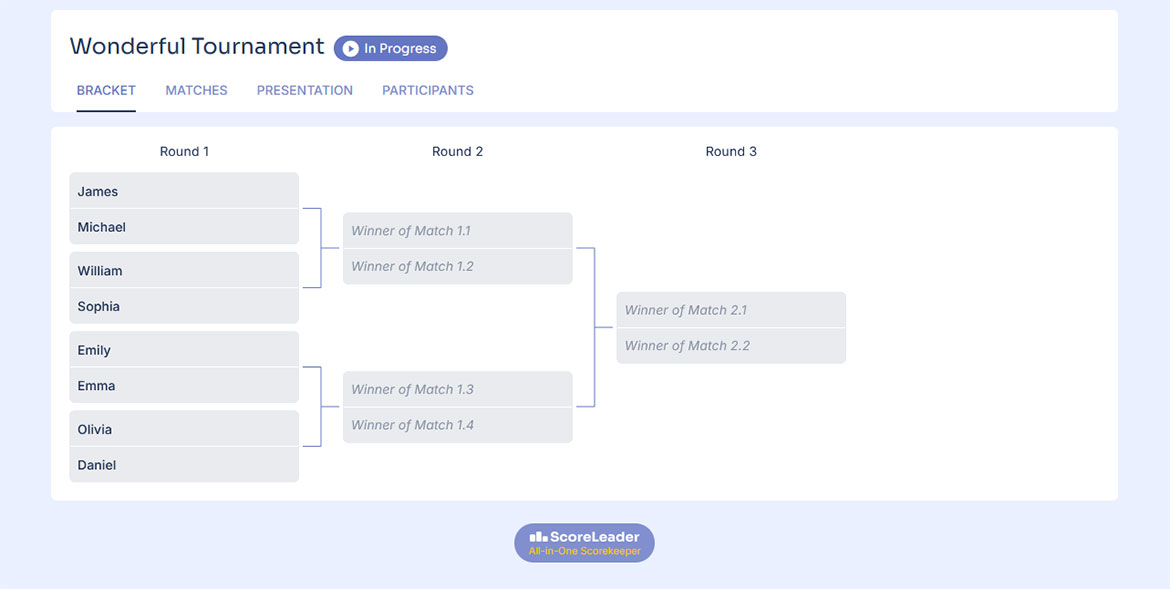
If you’ve ever watched a major sporting event, an esports championship, or even a local chess competition, chances are you’ve seen a tournament bracket. At first glance it may look like a simple diagram showing who plays whom. In reality, tournament brackets are carefully designed systems that determine how competitors advance, how winners are decided, and how fairness is maintained throughout the competition.
Understanding how tournament brackets work helps spectators follow events more easily and allows organizers to run competitions efficiently. Behind every bracket lies a mix of mathematics, probability, scheduling logistics, and competitive philosophy. From the iconic single-elimination bracket used in events like the NCAA March Madness to complex formats used in esports leagues, tournament brackets shape the entire competitive experience.
This guide explores the core principles behind tournament brackets, the most common formats, how seeding works, and why organizers choose one structure over another.
What a tournament bracket actually is
A tournament bracket is a visual representation of the structure of a competition. It maps out how participants compete against each other and how winners progress through rounds until a champion is determined.
Most brackets resemble a tree-like diagram. Competitors start on opposite sides, face off in early rounds, and advance toward the center where the final match takes place.
At its core, a bracket serves several important functions:
- Organizing matchups between competitors
- Tracking progress throughout the tournament
- Ensuring a fair competitive structure
- Providing a clear path to the championship
Without brackets, tournaments with dozens or hundreds of participants would quickly become chaotic.
Brackets are especially useful in knockout competitions, where losing a match often eliminates a participant from the tournament.
The anatomy of a bracket
Before diving into specific formats, it’s helpful to understand the basic components that appear in most tournament brackets.
Rounds
A round represents a stage of the competition in which participants play matches simultaneously or within the same timeframe.
Common round names include:
- Round of 64
- Round of 32
- Round of 16
- Quarterfinals
- Semifinals
- Finals
Each round reduces the number of competitors until only one remains.
Matches
A match (or game) is a contest between two competitors or teams. The winner advances to the next round while the loser may either be eliminated or moved to another bracket depending on the format.
Advancement paths
Lines connecting matches illustrate the progression path. They show exactly where the winner of one match goes next.
This structure allows both spectators and organizers to anticipate future matchups.
Final and champion
At the end of the bracket sits the final match, which determines the overall winner of the tournament.
Single-elimination brackets: the classic format
The single-elimination bracket is the most widely recognized tournament format. It’s used in countless sporting events, including tennis championships, many football competitions, and the famous college basketball tournament NCAA March Madness.
The concept is straightforward: lose once and you’re out.
Each round eliminates half of the participants. Winners move forward until only one competitor remains undefeated.
Example with 16 participants
A 16-player single-elimination bracket typically follows this structure:
- Round of 16 → 8 winners
- Quarterfinals → 4 winners
- Semifinals → 2 winners
- Final → 1 champion
Because each round halves the field, brackets usually contain numbers that are powers of two (8, 16, 32, 64, etc.).
Advantages of single elimination
This format has several major benefits:
Speed and efficiency
Single-elimination tournaments require relatively few matches. For example, a tournament with 64 competitors requires only 63 matches.
Excitement
Every match carries high stakes. One mistake can end a competitor’s run, which creates intense drama.
Simple structure
The bracket is easy to understand for both participants and spectators.
Drawbacks
However, single elimination has some limitations.
A strong competitor might be eliminated early due to a difficult matchup or an unlucky performance. Because of this, the format may not always identify the second-best competitor accurately.
Double-elimination brackets: giving competitors a second chance
To reduce the harshness of immediate elimination, some tournaments use a double-elimination bracket.
In this format, competitors must lose two matches before being eliminated.
The bracket is divided into two sections:
Winners bracket
All participants start here. Winners stay in this bracket.
Losers bracket
When a competitor loses once, they move into the losers bracket. Losing again eliminates them entirely.
Eventually, the winners bracket champion faces the survivor of the losers bracket in the grand final.
In many competitions, if the losers bracket finalist wins the first final match, a second deciding match is played because both competitors would then have one loss.
Double elimination is extremely popular in esports tournaments and fighting game competitions.
Benefits of double elimination
This system improves competitive fairness because one bad performance does not immediately eliminate a strong competitor.
It also produces more matches, which can be beneficial for viewers and event organizers.
Downsides
The biggest drawback is complexity. Double-elimination brackets are harder to follow, especially for casual spectators.
They also require significantly more matches than single-elimination tournaments.
Round-robin tournaments: everyone plays everyone
Not all tournaments rely on elimination brackets. Some use a round-robin format, where each participant competes against every other participant.
Instead of being eliminated after a loss, competitors accumulate points across multiple matches.
A typical scoring system might award:
- 3 points for a win
- 1 point for a draw
- 0 points for a loss
This format is widely used in international competitions like the group stage of the FIFA World Cup.
Advantages
Round-robin tournaments provide the most accurate ranking because everyone plays the same opponents.
Luck plays a smaller role compared to elimination formats.
Disadvantages
The main drawback is the large number of matches required. If 10 competitors participate, the tournament requires 45 matches.
Because of this, round-robin formats are often used in group stages before switching to elimination brackets.
Hybrid formats: combining multiple systems
Many large tournaments combine several structures to balance fairness, excitement, and scheduling.
A common example is:
- Group stage (round robin)
- Knockout stage (single elimination)
This approach allows competitors multiple opportunities early on while maintaining high drama in the final rounds.
The UEFA Champions League follows a similar structure. Teams compete in round-robin groups before advancing to knockout rounds.
Hybrid formats are also widely used in esports events and international competitions.
The role of seeding in tournament brackets
One of the most important aspects of bracket design is seeding.
Seeding ranks competitors based on skill level, past performance, or qualification results. The goal is to prevent the strongest participants from facing each other too early.
For example, in a 16-player bracket:
- Seed 1 plays seed 16
- Seed 2 plays seed 15
- Seed 3 plays seed 14
- Seed 4 plays seed 13
This arrangement ensures that the highest-ranked competitors only meet in later rounds if they continue winning.
Seeding is commonly used in professional tournaments such as Wimbledon Championships.
Byes: balancing uneven participant numbers
Sometimes the number of competitors doesn’t perfectly match a power of two.
In these cases, tournaments use byes.
A bye allows a participant to automatically advance to the next round without playing a match.
For example, if a bracket requires 16 competitors but only 14 register, two competitors receive byes in the first round.
Typically, the highest seeds receive these advantages to reward strong performance.
How tournament brackets are generated
In the past, brackets were created manually using printed charts or whiteboards. Today, most organizers rely on specialized software.
Several international platforms make bracket creation simple, such as the ScoreLeader’s Bracket Maker, which allows users to easily generate and share tournament brackets. It is ideal for sports, esports, and competitions of any size.
Why bracket design matters
The structure of a tournament has a huge impact on both competitive fairness and viewer experience.
A poorly designed bracket can create unfair matchups, eliminate strong competitors too early, or produce confusing tournament progressions.
Organizers must balance several factors:
- Number of participants
- Available time
- Competitive integrity
- Audience engagement
- Broadcast schedules
For example, large international competitions often prioritize formats that maximize excitement and storytelling.
The psychology of following a bracket
Part of the appeal of tournaments lies in the predictive challenge. Fans love forecasting outcomes and filling out brackets.
The popularity of bracket prediction games exploded thanks to events like NCAA March Madness, where millions of fans submit predictions each year.
Following a bracket gives viewers a clear narrative: underdogs rising, favorites collapsing, and unexpected champions emerging.
This storytelling element is one reason tournament brackets remain such a powerful format across sports and competitive games.
The enduring appeal of tournament brackets
Tournament brackets may look simple, but they represent a sophisticated system designed to organize competition, maintain fairness, and create excitement.
Whether it’s a local amateur event, a professional tennis championship, or a global esports tournament, the bracket provides the roadmap that guides competitors from the opening match to the final showdown.
By understanding the differences between single elimination, double elimination, and round-robin formats, spectators gain a deeper appreciation of how competitions unfold.
Ultimately, the bracket is more than a diagram—it’s the backbone of competitive structure. It transforms a collection of players into a clear journey toward one defining moment: the crowning of a champion.