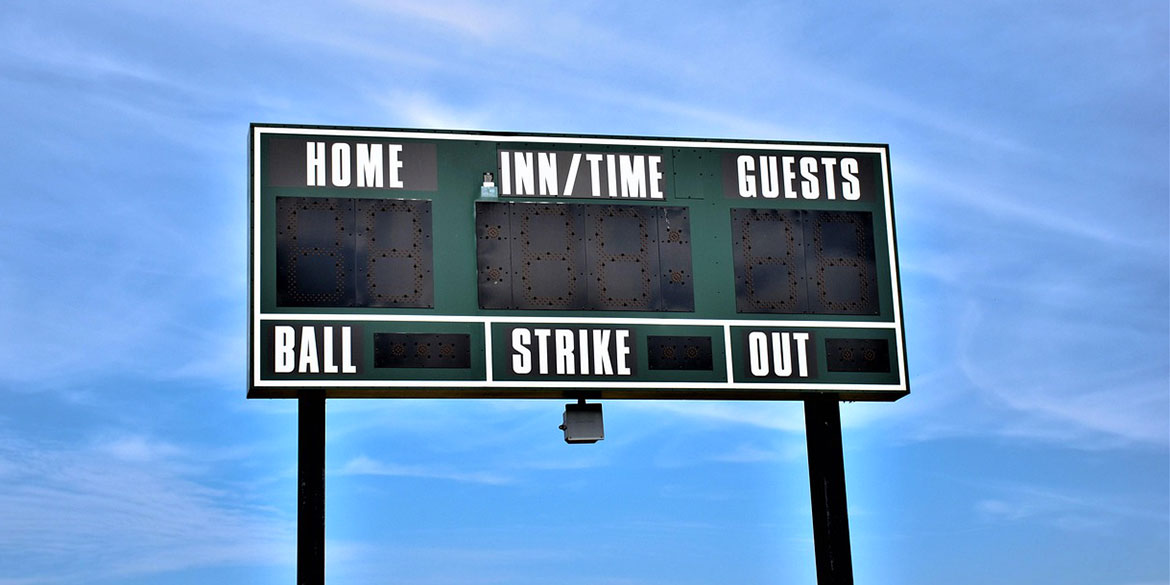
For someone discovering baseball, the scoreboard can feel strangely intimidating. Unlike sports where the score alone tells most of the story, baseball packs an enormous amount of information into a single display. Runs, hits, errors, innings, pitch counts, batting averages, substitutions, and mysterious abbreviations all compete for attention at once. At first glance, it may look like a wall of numbers designed only for lifelong fans.
But once you understand how a baseball scoreboard works, something interesting happens: the game suddenly becomes far more exciting. You stop merely watching players swing bats and throw pitches. Instead, you begin reading momentum, strategy, pressure, and performance in real time. A scoreboard becomes less like decoration and more like the heartbeat of the game itself.
Whether you are watching Major League Baseball (MLB), college baseball, Little League, or an international tournament organized by the World Baseball Softball Confederation (WBSC), the core structure of the scoreboard remains remarkably similar. Learning how to interpret it gives you immediate access to the rhythm and logic of baseball.
The basic layout of a baseball scoreboard
At its core, a baseball scoreboard is designed to answer three essential questions:
- Who is winning?
- What inning is it?
- How did the game unfold so far?
Most scoreboards place the two teams vertically, with the visiting team on top and the home team underneath. Across the top, you will usually see innings numbered from 1 through 9. Each inning column displays how many runs each team scored during that inning.
For example, imagine this simplified scoreboard:
| Team | 1 | 2 | 3 | 4 | 5 | 6 | 7 | 8 | 9 | R | H | E |
|---|---|---|---|---|---|---|---|---|---|---|---|---|
| Yankees | 0 | 1 | 2 | 0 | 0 | 1 | 0 | 0 | 0 | 4 | 9 | 1 |
| Dodgers | 0 | 0 | 0 | 1 | 0 | 0 | 0 | 2 | 0 | 3 | 8 | 0 |
This tells you several things immediately:
- The Yankees scored 4 total runs.
- The Dodgers scored 3 total runs.
- The Yankees collected 9 hits.
- The Dodgers collected 8 hits.
- The Yankees committed 1 error.
- The Dodgers committed none.
Even without watching the game, you can already reconstruct part of the narrative. The Yankees jumped ahead early, the Dodgers rallied late, and the ending was probably tense.
That ability to summarize an entire contest in a compact visual format is one reason baseball scoreboards are so iconic.
Understanding the line score
The inning-by-inning row is called the line score. It functions almost like a timeline of the game.
Every number under an inning represents how many runs a team scored during that specific inning only. A zero means no runs scored in that inning.
If you see a big number, such as a 5 in the sixth inning, that usually signals a dramatic offensive explosion. Fans often glance at the line score to identify momentum swings instantly.
Occasionally, you may see an “X” instead of a number in the bottom of the ninth inning for the home team. That means the home team did not need to bat because they were already leading after the top half of the inning ended. Since the home team already had the lead, the game was over before their turn arrived.
For example:
| Team | 1 | 2 | 3 | 4 | 5 | 6 | 7 | 8 | 9 | R |
|---|---|---|---|---|---|---|---|---|---|---|
| Cubs | 0 | 0 | 1 | 0 | 0 | 0 | 0 | 0 | 2 | 3 |
| Mets | 0 | 1 | 0 | 0 | 1 | 0 | 2 | 0 | X | 4 |
The Mets won 4–3, and because they were already ahead after the top of the ninth inning, they never batted in the bottom half.
What does R-H-E mean?
One of the most famous features of a baseball scoreboard is the trio of letters displayed near the final totals: R-H-E.
These stand for:
- R = Runs
- H = Hits
- E = Errors
This simple combination summarizes the offensive and defensive quality of each team’s performance.
Runs (R)
Runs are the most important statistic because they determine the winner. A run is scored when a player successfully circles all four bases and reaches home plate.
If Team A has 6 runs and Team B has 4, Team A wins regardless of other statistics.
Hits (H)
A hit occurs when a batter reaches base safely after putting the ball into play, without the help of an error or fielder’s choice.
Hits include:
- Singles
- Doubles
- Triples
- Home runs
Hits reveal how effectively a team produced offense. However, more hits do not always guarantee victory. A team can scatter many hits without converting them into runs.
For example, a team might record 12 hits but only score 2 runs because they repeatedly strand runners on base.
Meanwhile, another team may score 5 runs on just 6 hits thanks to timely home runs or clutch batting.
Errors (E)
Errors are often misunderstood by new fans. An error is charged when a defensive player makes a mistake that should reasonably have been avoided and that mistake allows a batter or runner to advance safely.
Common examples include:
- Dropping a routine fly ball
- Throwing wildly to first base
- Mishandling an easy ground ball
Errors matter because they often extend innings and create scoring opportunities that should not have existed.
A scoreboard showing multiple errors usually indicates sloppy defense or intense pressure situations.
Innings and game progression
Baseball games are divided into nine innings, and each inning has two halves:
- The top half, where the visiting team bats
- The bottom half, where the home team bats
A small indicator on the scoreboard usually tells you whether the game is in the top or bottom of the inning. This often appears as:
- “Top 5”
- “Bot 7”
- Or an arrow/light indicator
Understanding inning progression is essential because baseball has no game clock. Unlike basketball or football, baseball ends only after innings are completed and the leading team remains ahead.
This creates a unique tension. A team trailing by several runs can still mount a comeback late in the game because there is technically no limit on offensive opportunities until three outs are recorded.
Balls, strikes, and outs
Modern scoreboards nearly always include the current count:
- Balls
- Strikes
- Outs
These are usually displayed prominently near the inning indicator.
Balls
A ball is a pitch outside the strike zone that the batter does not swing at.
Four balls award the batter first base automatically, known as a walk.
Strikes
A strike occurs when:
- The batter swings and misses
- The pitch crosses the strike zone
- The batter hits a foul ball under certain conditions
Three strikes result in a strikeout.
Outs
Each team gets three outs per half-inning. Once three outs occur, the teams switch offense and defense.
The outs counter is incredibly important because it defines pressure. A rally with zero outs feels very different from a rally with two outs.
Experienced fans constantly track outs because they shape strategic decisions such as bunting, stealing bases, or pitching changes.
Base runner indicators
Many scoreboards include a small baseball diamond graphic showing whether runners occupy first, second, or third base.
These indicators light up as players reach base safely.
This feature may seem simple, but it dramatically improves your understanding of the game situation. A single runner on first creates moderate pressure. Bases loaded with two outs creates enormous tension.
Even casual viewers can instantly recognize danger when all three bases illuminate.
Pitch counts and velocity
Modern baseball increasingly emphasizes pitching analytics, and scoreboards now reflect that evolution.
You will often see:
- Pitch count
- Pitch speed
- Type of pitch
- Strikeout totals
Pitch count
Pitch count tracks how many pitches a pitcher has thrown during the game.
This matters because pitchers tire over time, and fatigue affects performance and injury risk.
If a starter reaches 90–110 pitches, fans often anticipate a pitching change soon.
Velocity
In professional baseball, scoreboards commonly display pitch speed in miles per hour.
Fastballs exceeding 95 mph generate excitement because elite velocity is difficult to hit. At the highest level, some pitchers now exceed 100 mph regularly.
Batting statistics on the scoreboard
Large stadium scoreboards frequently display individual player statistics alongside their names.
Common abbreviations include:
| Abbreviation | Meaning |
|---|---|
| AVG | Batting average |
| HR | Home runs |
| RBI | Runs batted in |
| OBP | On-base percentage |
| SLG | Slugging percentage |
Batting average (AVG)
Batting average measures how often a player gets a hit.
A .300 average means the batter gets a hit 30% of the time, which is considered excellent.
RBIs
Runs batted in track how many runs a player directly helps score with their batting.
A batter with many RBIs is typically effective in high-pressure scoring situations.
Why baseball scoreboards can seem complicated
Part of baseball’s charm lies in its statistical depth. The sport has evolved over more than a century, and scoreboards gradually became information hubs rather than simple score displays.
Older ballparks once featured hand-operated scoreboards with minimal information. Modern digital scoreboards resemble giant data centers filled with live analytics, video replays, probability models, and advanced metrics.
For newcomers, this density can feel overwhelming. But the key is understanding that you do not need to decode everything immediately.
Start with:
- Innings
- Runs
- Outs
- Balls and strikes
Once those become intuitive, the rest begins to make sense naturally.
Reading momentum through the scoreboard
One fascinating aspect of baseball is how much emotional texture a scoreboard can reveal.
Imagine these situations:
- A team has 10 hits but only 1 run.
- Another team has 3 hits but leads 4–1.
- A pitcher has thrown 105 pitches by the sixth inning.
- Bases are loaded with two outs in the ninth.
Even without commentary, the scoreboard tells a story.
You can sense frustration, dominance, tension, wasted opportunities, or impending collapse simply by reading the numbers carefully.
That storytelling quality is unique to baseball. The scoreboard acts almost like a compressed narrative engine.
Extra innings and special situations
If the score remains tied after nine innings, the game enters extra innings.
Additional inning columns may appear on the scoreboard, extending beyond the original nine. The game continues until one team finishes an inning with more runs than the other.
You may also encounter unusual scoreboard symbols:
- “F” for final
- Rain delay indicators
- Replay review notices
- Defensive substitutions
- Pinch hitters and pinch runners
As technology advances, scoreboards continue becoming more interactive and visually sophisticated.
Digital scoreboards and modern baseball apps
Today, fans rarely rely only on stadium displays. Mobile apps and websites provide real-time scoreboards packed with advanced statistics and visual tools.
Popular international platforms include ScoreLeader.
These services often include:
- Live pitch tracking
- Win probability graphs
- Animated strike zones
- Exit velocity data
- Defensive positioning maps
For modern fans, the scoreboard is no longer limited to the stadium wall. It has become an immersive second screen experience.
Final thoughts
At first glance, a baseball scoreboard may look overly technical, crowded, or even cryptic. Yet beneath those numbers lies one of the most elegant systems in sports.
Every section of the scoreboard serves a purpose. The line score reveals momentum. The R-H-E totals summarize execution. Balls, strikes, and outs define immediate tension. Base runner indicators visualize danger instantly. Advanced stats add strategic depth for dedicated fans.
Once you learn how to read these elements together, baseball transforms dramatically. Games become richer, smarter, and far more suspenseful because you are no longer simply watching action unfold — you are interpreting the hidden language of the sport in real time.
That is ultimately why baseball scoreboards endure as such an iconic part of sports culture. They do not merely display information. They tell the entire story of the game.