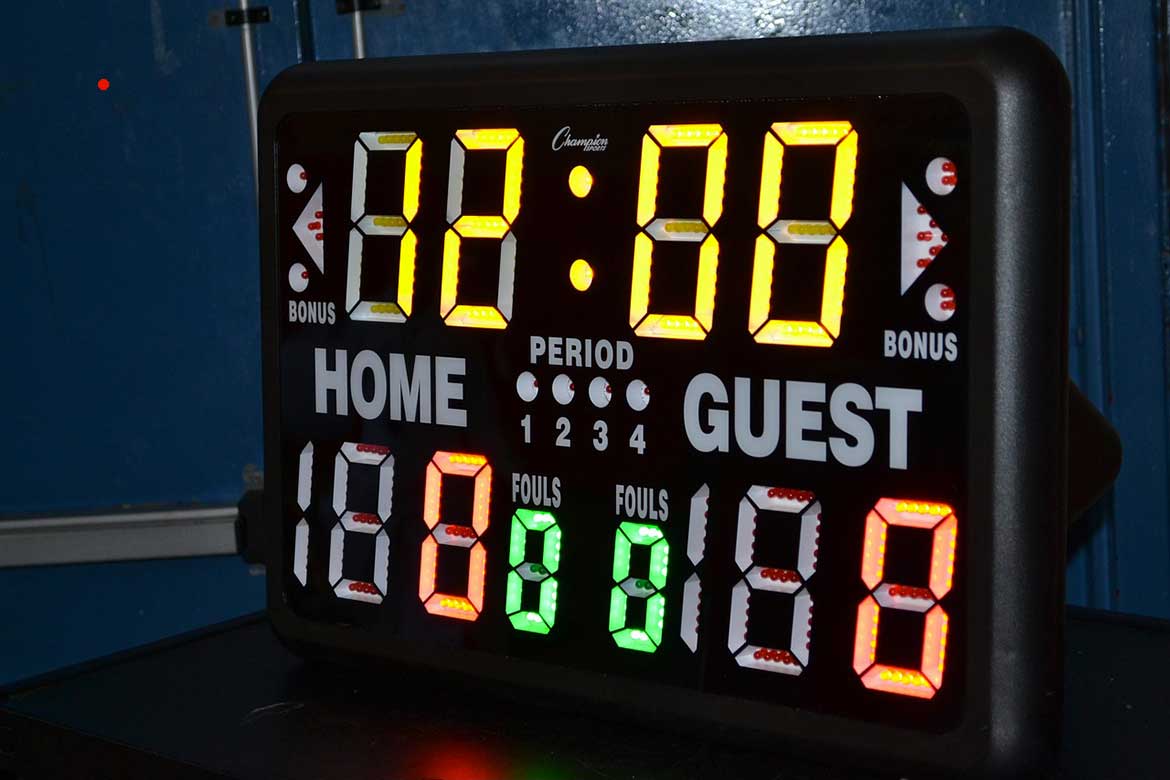
If you are new to basketball, the scoreboard can feel overwhelming. In just a few seconds, numbers change, lights flash, buzzers sound, and officials stop or restart the action based on information displayed above the court. Yet once you understand what every section of the scoreboard means, the game becomes dramatically easier to follow.
The scoreboard is much more than a simple display of points. It serves as the official source of information for players, coaches, referees, broadcasters, and fans. Every possession, substitution, timeout, foul, and strategic decision is influenced by the data shown on it. Whether you are watching an NBA, WNBA, NCAA, FIBA, or high school game, the overall layout remains surprisingly similar, although a few rules and timing details differ depending on the competition.
This guide explains every major element of a basketball scoreboard, from the obvious score to lesser-known indicators such as the team foul bonus, the possession arrow, the shot clock, and player foul counts. By the end, you will be able to glance at almost any scoreboard and immediately understand what is happening and why it matters.
The score: the most obvious number
At the center of every basketball scoreboard are the two numbers everyone watches: the score.
Each team accumulates points throughout the game. Although the principle is simple, knowing how those points are earned provides important context.
A standard field goal made inside the three-point line is worth 2 points. A successful shot from behind the three-point arc earns 3 points, while a made free throw counts for 1 point.
Unlike sports where scoring is relatively rare, basketball features constant changes to the score. Momentum can shift within seconds, especially because teams can quickly score multiple baskets on consecutive possessions.
The score alone, however, rarely tells the entire story. A team trailing by ten points with eight minutes remaining is in a very different situation than a team trailing by the same margin with only thirty seconds left.
That is why the other sections of the scoreboard are just as important.
The game clock: understanding how much time remains
The game clock indicates how much playing time is left in the current period.
Unlike sports such as soccer, basketball does not use a continuously running clock. Instead, the timer frequently stops for situations including:
- Fouls
- Violations
- Timeouts
- Out-of-bounds plays
- Instant replay reviews
- Made baskets during the final minutes in certain competitions
Because of these frequent stoppages, the final two minutes of a close game may take fifteen or even twenty minutes of real time.
The amount of playing time depends on the league.
The NBA and WNBA use four quarters of 12 minutes each. Most FIBA competitions, including international tournaments like the FIBA Basketball World Cup and the Olympic Games, feature four 10-minute quarters. NCAA men’s basketball is unique because it uses two 20-minute halves, while NCAA women’s basketball follows the four-quarter format.
When the game clock reaches 0:00 at the end of the final regulation period and the score is tied, the teams play overtime.
Quarter, half, or overtime indicator
Near the game clock, you will usually find an indicator showing the current stage of the game.
Depending on the competition, it may display:
- Q1, Q2, Q3, Q4
- 1st Half or 2nd Half
- OT, OT2, OT3, and so on
This small detail helps viewers immediately understand where the game stands.
For example, a five-point lead early in the first quarter is almost meaningless because plenty of time remains. The exact same lead with fifteen seconds left in overtime carries enormous significance.
The shot clock: why teams cannot hold the ball forever
One of basketball’s defining features is the shot clock.
Without it, a team could simply keep possession indefinitely after taking the lead, making games slow and uncompetitive. The shot clock forces the offensive team to attempt a field goal within a limited amount of time.
If the timer expires before the ball hits the rim, the officials call a shot clock violation, and possession is awarded to the opposing team.
The duration varies depending on the league.
The NBA and WNBA use a 24-second shot clock, as do all FIBA competitions. NCAA men’s basketball uses 30 seconds, while many high school leagues have adopted shot clocks ranging from 30 to 35 seconds, although requirements differ by jurisdiction.
Modern scoreboards display the shot clock separately from the main game clock, usually above each backboard as well as on the primary scoreboard.
Watching both clocks simultaneously becomes second nature for experienced fans. As the shot clock winds down, offensive teams often speed up their actions, creating dramatic last-second shot attempts known as buzzer beaters.
Team fouls: keeping track of physical play
Another critical area of the scoreboard displays team fouls, sometimes called team personals.
Every personal foul committed during a period contributes to this total.
The importance of team fouls extends beyond statistics. Once a team commits enough fouls within a quarter or half, the opposing team begins receiving free throws even on ordinary defensive fouls.
This rule discourages overly physical defense and rewards disciplined play.
Experienced viewers constantly monitor the team foul count because it influences coaching strategy.
For example, a defender who might normally pressure the ball aggressively may instead play more cautiously if the team is already close to the foul limit.
Likewise, offensive players often attack the basket more aggressively once their opponents have accumulated multiple fouls.
The bonus: what it means and why it changes the game
One of the most misunderstood scoreboard indicators is the bonus.
When you hear commentators say a team is “in the bonus,” they mean future defensive fouls will automatically send the opposing team to the free-throw line, even if the foul did not occur during a shooting attempt.
The exact threshold depends on the rules being used.
Under NBA rules, teams enter the penalty after committing a specified number of team fouls during a quarter. FIBA competitions generally award free throws after the fifth team foul in a quarter. NCAA rules differ between the men’s and women’s games due to their distinct game structures.
Many scoreboards illuminate a BONUS light when this situation begins.
Some displays even feature a DOUBLE BONUS indicator, particularly in competitions where an additional foul threshold awards two guaranteed free throws instead of a one-and-one opportunity.
This information dramatically affects late-game tactics.
If one team has already reached the bonus while the other has not, the trailing team may intentionally attack the basket instead of settling for perimeter shots, knowing that any defensive mistake could produce easy points from the foul line.
Conversely, defenders become increasingly careful about unnecessary contact.
The possession arrow: solving jump-ball situations
The possession arrow is another feature that often confuses newcomers.
Many basketball fans assume every tied-up ball results in another jump ball. That is no longer true in most leagues.
Instead, after the opening tip-off, alternating possession rules determine which team receives the ball in many held-ball situations.
The possession arrow points toward the team that will receive the next alternating-possession throw-in.
Once that team gains possession, the arrow immediately switches to the other side for the following alternating-possession situation.
Imagine two players firmly grab the basketball at the same time, and neither gains control.
Rather than conducting another jump ball at center court, officials simply look at the possession arrow.
If it points toward the home team, the home team receives the inbound pass.
Immediately afterward, the arrow flips toward the visiting team.
Although this appears to be a small detail, it can become extremely important during close games, especially in the closing seconds when every possession has tremendous value.
Player fouls: keeping an eye on individual discipline
Besides showing team fouls, many scoreboards also display individual player fouls, either on the main board or on auxiliary displays around the arena.
Every personal foul matters because players are limited in how many they can commit before being disqualified from the game. In the NBA and WNBA, a player fouls out after six personal fouls. Under FIBA rules, as well as in most international competitions, the limit is five. Many college competitions also use different limits depending on their governing body.
This information is incredibly valuable for coaches. Imagine a team’s star player picks up a fourth foul early in the third quarter. The coach now faces a difficult decision: keep that player on the floor and risk losing them entirely, or substitute them to preserve their availability for the closing minutes.
Fans who pay attention to the foul count often understand coaching decisions that might otherwise seem puzzling. A key player sitting on the bench is not necessarily injured or underperforming—they may simply be in foul trouble.
Timeouts: strategic pauses that shape the game
Another common scoreboard element is the number of timeouts remaining for each team.
Timeouts allow coaches to stop play, organize their team, discuss tactics, make substitutions, or simply give players a chance to recover physically.
Late in close games, timeouts become especially valuable. Coaches frequently use them to draw up a final offensive play, advance the ball under certain rule sets, or disrupt the rhythm of the opposing team after a scoring run.
Because timeout rules vary between leagues, the exact number available differs from one competition to another. Nevertheless, the scoreboard always provides an up-to-date count so everyone knows how many strategic breaks each team still has available.
Running out of timeouts can significantly limit a coach’s options during the final minutes.
The relationship between the game clock and the shot clock
One of the most fascinating aspects of basketball strategy comes from the interaction between the game clock and the shot clock.
These two timers constantly influence offensive decision-making.
Consider a situation where there are 40 seconds left in the game and the shot clock is 24 seconds.
The offensive team has a choice. They can shoot relatively early, leaving enough time for the opponent to respond, or they can use nearly the entire shot clock before attempting a shot, reducing the opponent’s remaining time.
Now imagine there are only 18 seconds left in regulation while the shot clock still shows 24 seconds.
Because the game clock will expire before the shot clock, the offensive team can simply maintain possession until the final seconds before attempting the last shot. Commentators often describe this as playing for the “last possession.”
Understanding this relationship explains many coaching decisions that may seem unusually patient or surprisingly aggressive.
Overtime: when regulation is not enough
If the score is tied when regulation ends, the game moves into overtime.
Most scoreboards replace the quarter indicator with OT, while additional extra periods are usually labeled OT2, OT3, and so on.
Each overtime period has its own duration according to the competition’s rules. During overtime, the scoreboard continues to track virtually all of the same information, including the game clock, shot clock, fouls, and timeouts.
Because every overtime period starts with a tied score, games often become even more intense. Coaches must carefully balance aggressive play with foul management, while players have to maintain their physical and mental focus despite already completing a full game.
Home and away identifiers
Although it seems obvious, every scoreboard clearly identifies the home and away teams.
The home team’s score is often displayed on the left, but this is not universal. Arena layouts, television broadcasts, and tournament organizers sometimes use different conventions.
For this reason, experienced viewers always check the team names rather than assuming one side always represents the home team.
Modern scoreboards frequently enhance this information with team logos, official colors, mascots, or abbreviations, making it easy to distinguish between the two sides even from a considerable distance.
Player numbers and scoring summaries
In professional arenas, scoreboards often display far more than the game’s essential statistics.
Large video boards may identify:
- The player who just scored
- The number of points scored on the play
- Individual player statistics
- Assists
- Rebounds
- Shooting percentages
- Total points for each player
These features are particularly useful for spectators attending games in person, allowing them to follow individual performances without needing a separate statistics sheet.
Broadcasters also rely on this information when discussing standout players during the game.
Replay reviews and official decisions
Basketball has increasingly embraced instant replay, especially at the professional and international levels.
When officials review a play, the game clock stops while referees examine video footage to confirm or overturn a decision.
Although scoreboards do not always explicitly display the reason for a review, many modern arenas indicate that an official review is in progress. During this time, fans often see replays on the giant video screen while the referees consult the available camera angles.
Reviews commonly involve questions such as whether a shot beat the buzzer, which team last touched the ball before it went out of bounds, whether a foul occurred before time expired, or whether a shot should count for two or three points.
Understanding the buzzer
Few sounds in sports are more recognizable than the basketball buzzer.
The buzzer marks the end of each quarter, overtime period, or shot clock.
However, not every buzzer has the same meaning.
A loud arena buzzer typically signals the expiration of the game clock, while a separate tone may indicate that the shot clock has run out. In many arenas, these sounds are intentionally distinct so that players and officials can immediately recognize which clock has expired.
If a player releases the ball before the game clock reaches 0.0, the shot may still count if it enters the basket legally after the buzzer sounds. This is why officials occasionally review last-second plays frame by frame.
Why scoreboards sometimes look different
Although basketball scoreboards share the same basic purpose, their appearance can vary dramatically.
A local high school gym may feature a relatively simple electronic display showing only the score, period, game clock, and team fouls.
By contrast, modern professional arenas often feature enormous high-definition video boards capable of displaying live statistics, advanced analytics, player introductions, sponsor content, crowd prompts, and multiple camera angles simultaneously.
Despite these visual differences, the core information remains remarkably consistent across virtually every level of basketball.
Once you understand the fundamentals, you can comfortably follow games almost anywhere in the world.
Common scoreboard abbreviations
Basketball scoreboards use numerous abbreviations to save space.
Some of the most common include:
- BONUS: The opposing team receives free throws after certain defensive fouls.
- POSS: Indicates the current possession arrow.
- PER or QTR: The current period or quarter.
- FOULS or PF: Team or player personal fouls.
- TO: Timeouts remaining.
- OT: Overtime.
- CLK: Clock.
- PTS: Points.
Learning these abbreviations makes reading unfamiliar scoreboards much easier, particularly when watching international broadcasts.
Reading a scoreboard like an experienced fan
Experienced basketball fans rarely focus on just one number.
Instead, they quickly scan several areas of the scoreboard to understand the full situation.
They look at the score, then immediately check the remaining time. Next, they notice the shot clock to determine whether the offense is under pressure. They glance at the team foul count to see whether either side is in the bonus and pay attention to the possession arrow if the game is close.
Within just a few seconds, this combination of information paints a remarkably complete picture of the game’s tactical landscape.
For example, imagine Team A leads by three points with 52 seconds remaining. The shot clock shows 20 seconds, Team B is already in the bonus, and Team A has only one timeout left.
Even before the next possession begins, an experienced viewer can anticipate several likely strategies. Team A will probably use a significant portion of the shot clock before attacking, while Team B will defend aggressively without committing unnecessary fouls. If Team A reaches the free-throw line, every successful attempt becomes increasingly valuable.
This ability to interpret multiple scoreboard elements simultaneously is what transforms casual viewers into knowledgeable basketball fans.
Final thoughts
At first glance, a basketball scoreboard may appear to be nothing more than a collection of clocks, numbers, arrows, and flashing lights. In reality, it serves as the game’s central information hub, providing the context needed to understand every possession, coaching decision, and strategic adjustment.
The score tells you who is winning, but the game clock reveals how urgent the situation has become. The shot clock dictates offensive pace, while team fouls and the bonus influence defensive intensity and free-throw opportunities. The possession arrow quietly determines who receives the ball during alternating-possession situations, and timeouts, player fouls, and overtime indicators complete the picture.
Once you know how each of these elements works—and, more importantly, how they interact—you begin to appreciate basketball on an entirely different level. Every glance at the scoreboard becomes meaningful. Rather than seeing isolated numbers, you recognize the story unfolding in real time: which team controls the momentum, which players are under pressure, how coaches are adapting their tactics, and what might happen next.
That deeper understanding is one of the reasons basketball is such a captivating sport. The scoreboard is not merely keeping score—it is telling the game’s story, one second, one possession, and one decision at a time.